
Magic Secret For Consistency: The Big4 (Part 4)
Welcome back to our Big Four archery fundamentals series. Be sure to catch up on Part 1, Part 2, and Part 3. In each of these articles, we laid the groundwork for achieving consistent shot quality.
Bows today are so accurate and consistent that they shoot better than we do. When shot with a shooting machine, compound bows can hit the same arrow hole repeatedly. We are the variation. It’s the shooter and changes in body pliability, position, and overall pressure and direction, shot to shot, that cause larger groups and fliers. It’s a tough pill to swallow, but it really is us. There is no magic tune or setting, arrow spine, fletching style, point weight, peep height, or stabilizer configuration that will make us group tighter until we tighten up our shooting procedure, form, and mental game.
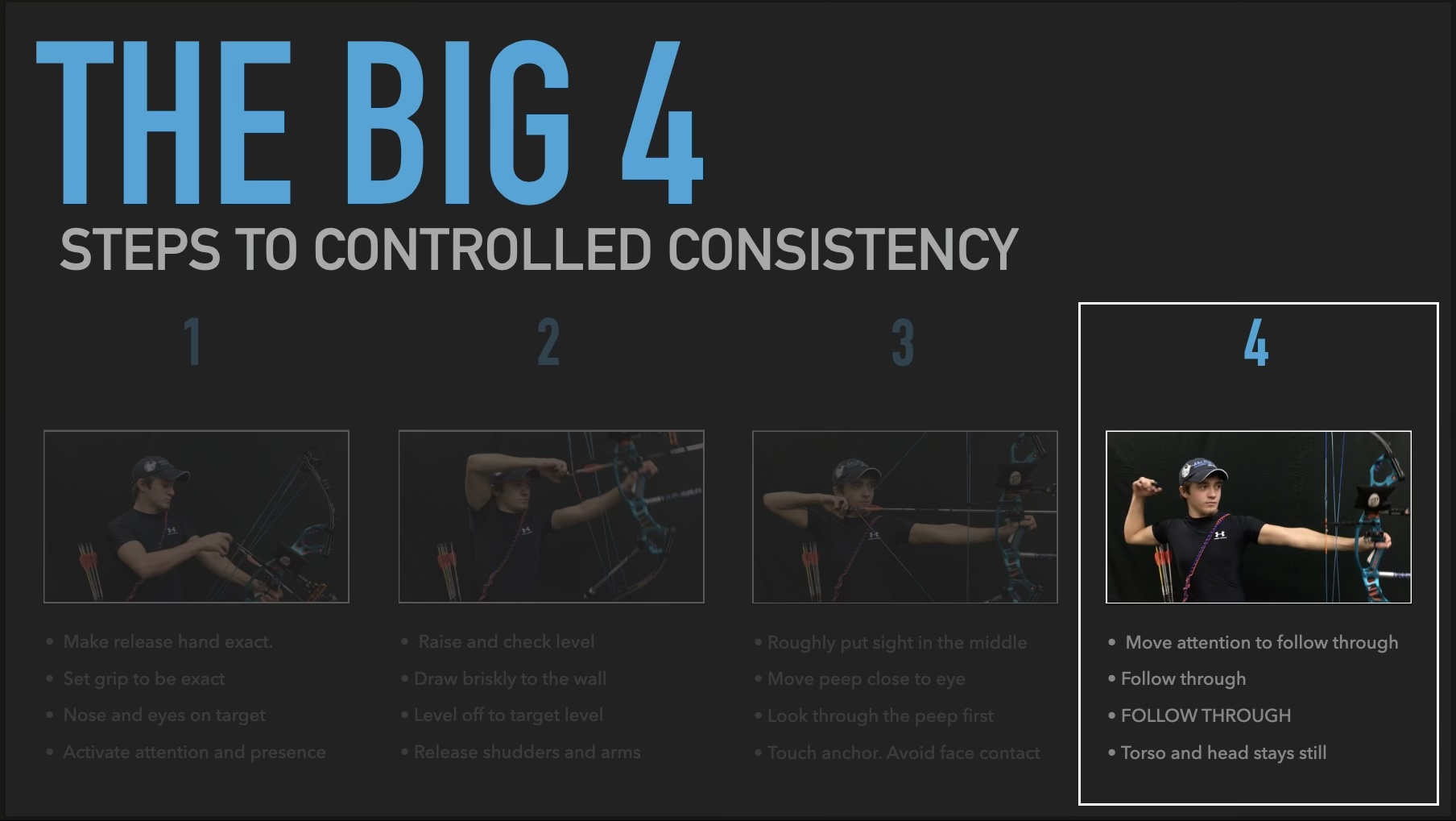
Today, we have finally arrived at Part Four of the Big Four – The follow-through. All the way at the end of the process, follow-through is often shortchanged or altogether skipped by many shooters, and it can be the most important “make or break” step.
Quick Recap of Parts One, Two, and Three
Step One: Fingers in the release and hand in the grip. We covered how to set both properly and why this foundation matters.
Step Two: Full draw and relaxation. We learned how to reach full draw, take a big clarifying breath, release shoulder tension, and adjust posture for uphill/downhill targets or changing elevations.
Step Three: Setting the pressure and direction of the shot directly on the target. We learned how to keep our bodies still and put the bow to our faces. With those steps in place, the final step brings it all together into a perfect shot.
Part Four: Follow Through
So you’re at full draw. You’re on target. Now, execute and finish dead on. The follow-through step is both a mental and physical process. Many people think it’s not that important because within a nanosecond, the arrow is fifteen feet in front of the bow, and there’s not much you can do after the release opens. However, a lot happens in a short span of time. When the release opens, the bow will change shape, and its mass moves forward as the arrow launches. The mental aspect of follow-through is the single most effective shot saver. I can’t count how many times I have saved a shot that was a crucial final game arrow, shoot-off shot, or shot on big game. It works by mentally committing to staying up and on target, reaching for the feel, and aiming straight at the target, while keeping the release reaction away from the middle of the target. I imagine, no matter the outcome, I’ll make it look perfect. If someone was watching me instead of the arrow’s impact point, I’d want them to see a perfect shot and know it hit the middle. This may seem small, but it sets the shot’s intention and influences how good the outcome will actually be. Many people only focus on keeping the pin still. Some only think about making the release fire smoothly. Choosing follow-through as your final focus allows your brain to align all the important steps to ensure the shot’s success. If you’re only aiming at this stage, the rest of the process might become more random. It’s amazing how much mental commitment to the shot improves your score and overall accuracy. As they say, archery is 90% mental. I often ask in my workshops how much time people spend practicing their mental game. The answer is usually zero.
The physical aspect of follow-through involves maintaining focus and sustaining effort for a moment or two after the shot is fired. Shooters often relax and flow once they feel the release break, but over time, the timing between the release break and the relaxation shrinks until they are perfectly in sync or even before the release. This leads to anticipation of the shot, which
can completely ruin your group’s performance or cause that critical final shot to go wrong as pressure increases. Target panic is a separate issue, but the follow-through is a crucial part. Good coaches can identify follow-through issues and emerging target panic problems by examining the arrow pattern after a round is complete. Take a look at these target patterns, and I’ll show you how to spot them in your own shooting so you can identify problems early and prevent them from becoming habitual.
Patterns

This pattern, with a right-handed shooter, shows anticipation of the release. This radiating-to-the-right pattern shows relaxation of the shooting effort at the same time as the release. The bigger the delay, the farther the arrow misses.

This pattern, with a right-handed shooter, shows sloppy follow-through. The bow arm falls low and left. The torso rotates and leans back, and the arrow heads to the target. You can also see the action as if the head is following the release hand as it moves backward.
Both of these patterns can be fixed. Basically, keep the pin on target until the arrow hits, while maintaining the shot’s strength and shape. The first image, which shows high right hits, will require work on target panic or shot execution anticipation to be fully corrected. So there you have it. The Big4 steps to consistency will do more than any magic tune on your
bow. A properly tuned bow will make your gear more forgiving of mistakes. However, the Big4 will minimize those mistakes and reduce their frequency. You’ll have tighter groups and better overall scores.
Want To Train Part Four With Me?
You can get personal coaching—either online via Zoom or in person— by visiting ImproveMyArchery.com. I coach compound, Olympic recurve, and barebow for all ages and skill levels.
Archery is my life, and if you’re serious about getting better, I’d love to work with you.

About the Author


Comments (0)