
Pro Arrow Building, Start to Finish. Cutting, Deburring, Gluing, Fletching, and Field-Proofing
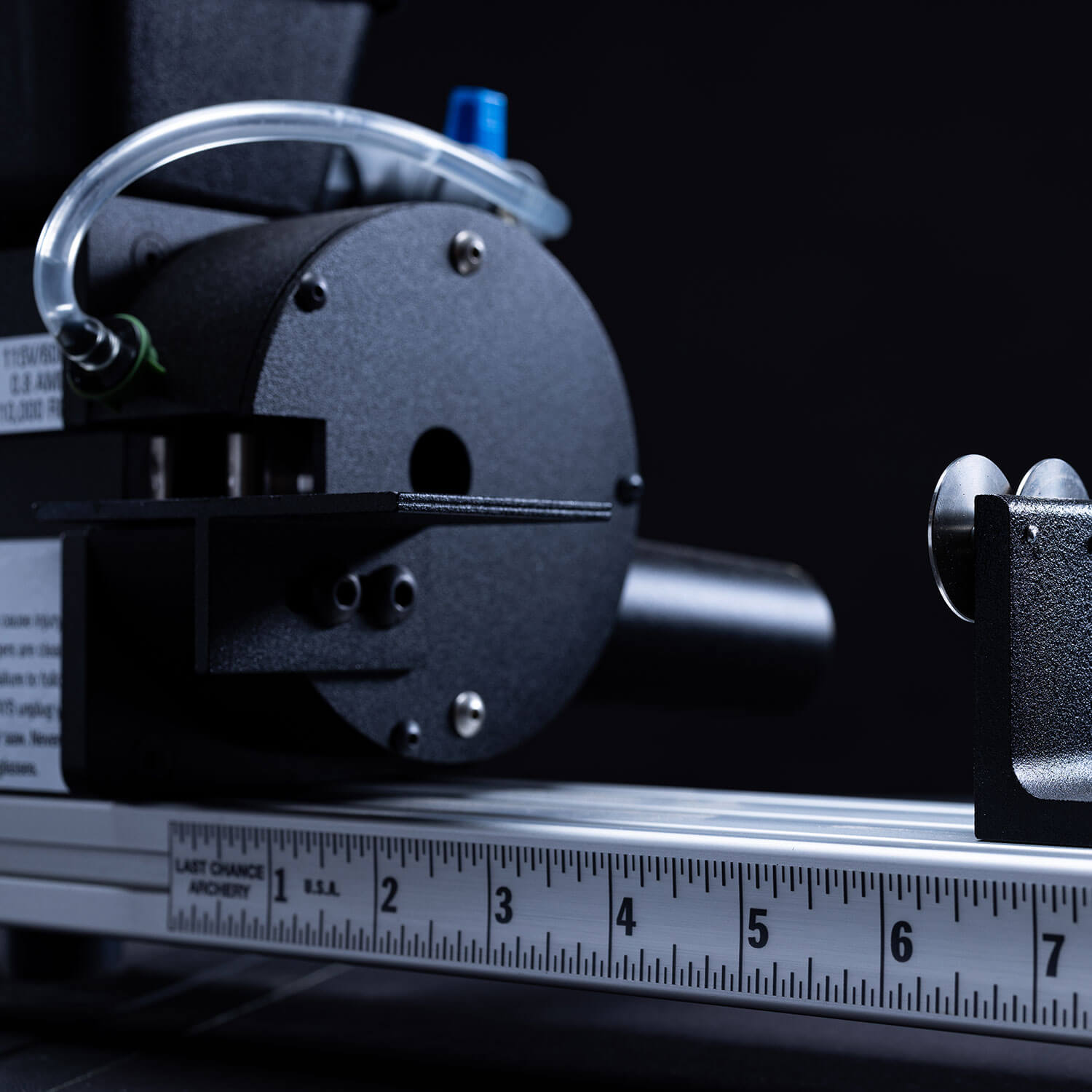
Want arrows that fly the same every time—at 20 yards or 90 meters? This tutorial distills a live demo into a clean, repeatable workflow. You’ll learn how to use the Last Chance Archery Revolution Arrow Saw, prep and glue points/inserts the right way, set arrow length for better rest interaction, prioritize nock straightness (it matters more than you think), and fletch with surgical repeatability on a Vane Master Pro.
What You’ll Use
- LCA Revolution Arrow Saw (10,000 RPM, quiet, water-drip + vacuum dust control)
- Integrated tools on the saw: deburring tip, barrel brushes & mops, face-squaring sanding port, arrow spinner, adjustable support and blade guard, “thumb shelf” for steady cuts
- Scotch-Brite pad or fine abrasive
- Hot-melt (or your preferred ferrule glue), small torch/heat source
- Vane Master Pro (or comparable precision fletching jig)
- Field tips (for safely heating inserts)
- Your vanes/feathers, adhesive, and cleaning supplies
1) Cutting & Squaring with the Revolution Saw
Why this saw setup matters
- 10,000 RPM motor = fast, clean cuts with less blade pressure.
- Water drip + vacuum traps carbon dust at the blade, reducing airborne mess and saving your shop vac.
- Adjustable support & blade guard keep the shaft parallel to the blade for thick and thin shafts (e.g., 27 series vs micro shafts).
- Thumb shelf lets you roll the arrow into the blade without flexing the middle (avoids angled cuts).
Cut procedure (repeatable and clean)
- Vacuum ON first, then start the water drip.
- Set length; slide/lock the arrow support so it meets the stop cleanly with or without vanes.
- Use the thumb shelf and roll the shaft through the blade—don’t push down on the middle.
- Deburr immediately using the built-in cone.
- Square the face: insert shaft into the sanding port, rotate until the front edge is uniformly smooth and square.
- Clean the ID with a barrel brush, then a mop. (You should see minimal dust thanks to the water+vacuum system.)
- Lightly soften the edge with a Scotch-Brite pad for easier point insertion.
Pro tip: If your shop used to go silent when someone fired up the old saw—this one’s quiet enough to talk next to.
2) Glue Points/Inserts the Right Way (Zero “Buzz”)
The most common long-range inconsistency? Loose, poorly bonded long-shank points. If glue gets scraped off at the lip and never reaches the inside interface, the point can rattle—and that rattling arrow won’t group.
The deburr that makes the bond
- Put a crisp ~45° internal chamfer at the mouth of the shaft (use the cone + Scotch-Brite).
- This creates space for glue to flow inside instead of being shaved off at entry.
Safe heating & glue technique (points)
- Keep your torch low. If it’s too hot for fingers, it’s too hot for the shaft bond.
- Warm the point lightly—not scorching.
- Apply a generous dollop of glue to the ferrule.
- Insert with a gentle in/out motion to work glue between shaft wall and ferrule, into grooves/ridges.
- As glue cools, wipe minimal excess. (If most glue ends up outside, not enough stayed inside.)
Bushings & inserts tricks
- Bushings (nock end): use a barrel brush as a holder—heat, glue, insert; keep spinning until the glue grabs, then pull the brush free.
- Inserts (point end): thread a field tip into the insert as a handle. The steel tip slows heat transfer so you don’t scorch fingers or overheat parts.
The “buzz test”
- Drop each arrow on a hard floor point-down from a couple inches.
- Any rattle/buzz = redo the bond. (Elite para archer Matt Stutzman reinstalled all his points mid-event after a buzz test—and his scores rose.)
3) Choose Arrow Length for a Quieter Rest (Find the Node)
Where your rest blade supports the shaft changes how the shaft “skips” during launch.
- If the support point is wrong, the shaft bounces and you’ll fight high/low tears and poor vane clearance.
- Slide the support point (or lengthen the overhang) until the shaft doesn’t bounce off the blade when “launched.”
- This is effectively finding a vibration node for a release-driven compound: the rest sees less downforce right where you want it.
- Expect tighter groups at distance and cleaner vane clearance—especially with small-diameter arrows.
4) Nock Straightness > Shaft Straightness
Peer-reviewed testing shows: a shaft that’s a few thousandths out can still group—if the nock is straight. A pristine .001″ shaft with a crooked or worn nock won’t.
Best practices
- Replace nocks regularly, especially before majors. Snapping on/off wears the throat.
- Track arrows 1–3 to 1–3 targets for a few weeks. If “#2” groups slowly open, replace its nock—you’ll see the group snap back.
- Spin check by hand: most trained shooters can feel ~0.003″ wobble by finger-spin alone. Use it.
5) Fletching for Repeatability (Vane Master Pro)
If you want arrows you can clone a year later, the Vane Master Pro’s indexable metrics (nock extension, helical index 1–5, left/right clamps/wires) make settings portable.
Set once, save forever
- Nock extension: exact distance from vane rear to bottom of nock groove.
- Helical index (1–5): repeatable rotational wrap.
- Left vs Right helical: choose based on cable clearance, not handedness.
- Right-handed shooters often get better clearance with left helical (fletch path straddles cables more cleanly).
- “Arrow clocking” mainly follows string twist, not magic carbon layup. Accuracy differences are negligible—choose for clearance.
Where to place the vanes
- Position vanes so they do not touch your face at anchor.
- Even light face contact (high-let-off bows especially) can kick a right-hander left (left-hander right), and broadheads exaggerate it.
Face-contact test
- Shoot without touching your face with the arrow/vanes/string (minimal reference contact).
- If impact shifts when you add contact, you’ve been “sighting in” the error. Adjust vane distance or anchor to remove contact—and re-sight clean.
Example indoor setup
- 2″ broadhead-style vane, left helical, index = 3 (good spin and drag without rest interference).
- Align clamp wires so the entire vane base lies flush on the shaft (no lifted corners).
6) Field Checklist (Before You Call Them “Done”)
- Cut: parallel, clean edge (no angle marks).
- Deburr/Chamfer: sharp lip removed; crisp ~45° inside edge.
- Square: front face shows uniform sanding ring.
- Clean ID: brush + mop (no residue).
- Glue: point/insert fully seated, no buzz on drop test.
- Spin: shaft + point true; nock visually straight.
- Fletch: settings logged; vanes clear face and cables; helical chosen for clearance.
- Paper/Group: verify rest node choice—no “skip,” clean tears, groups tighten at distance.
Troubleshooting Quick Hits
- Random fliers at longer range → Buzz test the points; replace suspect nocks.
- Persistent high/low paper tears → Re-evaluate rest support point (node), not only blade stiffness.
- Left/Right misses that come and go → Check face contact with vanes/string; re-place vanes or refine anchor.
- Noisy, dusty cutting → Vacuum before water; check drip onto blade/shaft junction.
- Vanes lifting at one corner → Adjust VMP wires/clamp so the base fully matches the shaft curvature.
Wrap-Up
Great arrows aren’t an accident. With a dust-safe cutting workflow, proper deburr and face-square, glue that actually bonds inside the shaft, nocks you refresh on schedule, a rest support point at the node, and fletching that’s measured and logged, you’ll build sets that survive tournament scrutiny—and repeat next season.
About the Author


Comments (0)